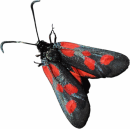
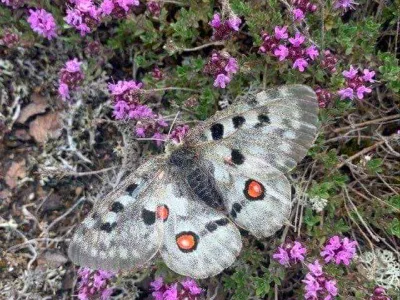
The paper Distance of movement in three threatened butterfly species investigates movement distances in three threatened butterflies: Euphydryas aurinia (marsh fritillary), Parnassius apollo (Apollo), and Phengaris arion (large blue).
More than 9,600 individual observations collected over eight years on the island of Gotland were analysed to quantify how far these species move within and between suitable habitats. The study shows that while most individuals remain within a few hundred meters of their emergence site, some butterflies travel several kilometres, demonstrating that rare long-distance dispersal events play an important role in maintaining genetic connectivity between populations.
The results highlight clear differences between species. E. aurinia exhibited the shortest movement distances, P. apollo the longest, and P. arion an intermediate pattern. Movement was typically concentrated within resource-rich areas, with occasional longer, directed flights to new habitats.
These findings provide essential insights for the conservation of threatened butterflies. To sustain viable populations, habitat patches need to be located within dispersal range—typically a few kilometres—for most individuals. For more sedentary species, establishing ecological corridors or stepping-stone habitats may be necessary to maintain landscape connectivity.