Central Research Questions
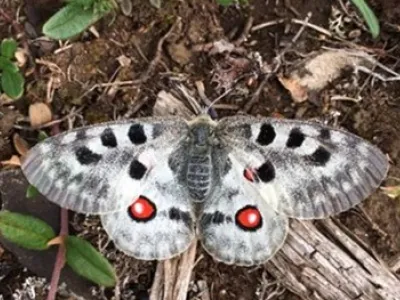
This thesis is led by Hedda Brunbäck Larsen and explores the ecology of P. apollo through the following questions: How does habitat quality affect the behavior and population density of P. apollo? What do the time budgets of larvae and adult P. apollo look like? What factors influence the oviposition site selection of female P. apollo? And how does the distribution of host plants and nectar sources relate to its density and distribution?
Background and Aims
The Apollo butterfly is red-listed as near threatened (NT), with a declining population in Europe. On Gotland, one of the remaining strongholds, the species inhabit alvar grasslands as well as areas of limestone coniferous semi-open forests. The loss of habitat and habitat fragmentation increases the risk of extinction, and the increasingly dry summers seem to negatively affect the host plant and nectar sources of the Apollo. The unusually dry spring of 2025 may further stress these populations, potentially affecting larval development and host plant availability. While previous work from Franzén et al. (2024) documented substantial populations across large areas on Gotland that are ideal for comprehensive study, critical gaps remain in our knowledge of how habitat quality influences these populations. My project aims to fill these gaps by providing ecological data through investigating how variations in habitat quality affects P. apollo behaviour, population densities, and egg-laying preferences to identify key factors for effective conservation on Gotland.
Methods
This project is carried out on northern Gotland close to Slite, with fieldwork taking place from mid March to the end of August 2025. The fieldwork involves multiple methods across areas of different habitat quality. Individual P. apollo are observed to investigate time budget analysis for both adults and larvae, using focal animal sampling to record the time spent on specific behaviours such as feeding, resting, moving, sunbasking, and mating. Density estimations are also carried out to compare adults and larvae, using transect walks across the habitat for both larvae and adults. This is done in 9-hectare grid cells across 3 different areas (27 in total), each ranked as low, medium, or high quality for the species.
To perform a habitat assessment, encounters during behavioural analysis are marked with a flag, and their coordinates are recorded in Fieldmaps to allow the areas to be revisited. The abundance and distribution of host plants (Sedum) and nectar sources within these areas are then examined, along with temperature measurements. Coordinates are also recorded in Fieldmaps when oviposition sites are observed. At these sites, the distance to and abundance of host plants, substrate, and tree/bush cover within the defined areas (>10 m), as well as temperatures, are assessed. To assess habitat quality along the transects, vegetation plots are distributed along the transect, where host and nectar plant abundance and vegetation height are measured.