Central Research Questions
This thesis is led by Ronja Kooiman and studies the Marsh fritillary's, Euphydryas aurinia, landscape occupancy and population recovery seven years after an extreme drought, through the following questions: What is the occupancy of suitable habitat patches? What are the population dynamics over time? How does E. aurinia recover in previously extinct patches? And what is the impact of weather events on population dynamics and habitat preferences?
Background and Aims
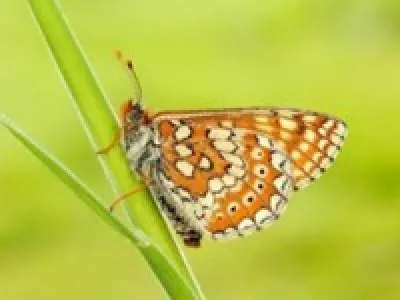
E. aurinia is a threatened butterfly across Europe. Its one-year life cycle consists of three stages: eggs, larvae, and butterflies. Eggs are laid under leaves of the host plant (Succisa pratensis), larvae spin silken nests around host plants before hibernating, and the species lives as a butterfly between late May and late June in Sweden.
Methods
E. aurinia is surveyed near Slite on Gotland during the summer of 2025 (end May–end June). In this area, the habitat of E. aurinia comprises wet parts of unfertilized calcareous wet grasslands that in most places remain naturally open due to poor soil and slow accumulation of humus. In this habitat, vegetation is sparse, making Succisa pratensis one of the few plants surviving.
The methods include a capture-mark-release (CMR) study during the flight period to assess local population sizes. Individuals are captured, marked, and released along irregular routes focused to cover suitable habitat that the species utilises. Adults are marked using a permanent marker pen and immediately released at the point of capture. Temperature, light intensity, and proximity to the forest are recorded with temperature loggers to study butterfly activity in relation to daily temperature patterns. These CMRs take place at Filehajdar and Högstensvät, close to Slite, covering a population that went extinct due to the 2018 drought. Knowledge about the recovery of E. aurinia is useful for future recovery projects.
During the peak flight period (3 May–13 June), patch occupancy across the entire habitat patch network is recorded. Vegetation and host plant abundance are measured using transects to provide a more detailed habitat quality assessment than the current data can give. The species, height, abundance, and largest leaf size are recorded, and pictures of the vegetation are taken to be analysed partly with the help of AI later.
The data gathered from this research is compared to data collected in previous years and contributes to the existing knowledge about E. aurinia. This includes a follow-up of the habitat patch cluster that went extinct after the 2018 drought (Högstensvät), which has not been surveyed since 2020. Insights into population dynamics, habitat utilization, and butterfly behaviour directly inform restoration strategies. For example, understanding host plant requirements and habitat preferences can guide vegetation management, data on population resilience can help predict the response to environmental stressors like drought, and improved ecological knowledge can support restoration efforts, enhance habitat connectivity, and support biodiversity conservation.