
Year
2020
Publication type
Peer-reviewed article
Journal
Journal of Vegetation Science
Volume
32
Issue
1
Article number
e12966
Files
Abstract
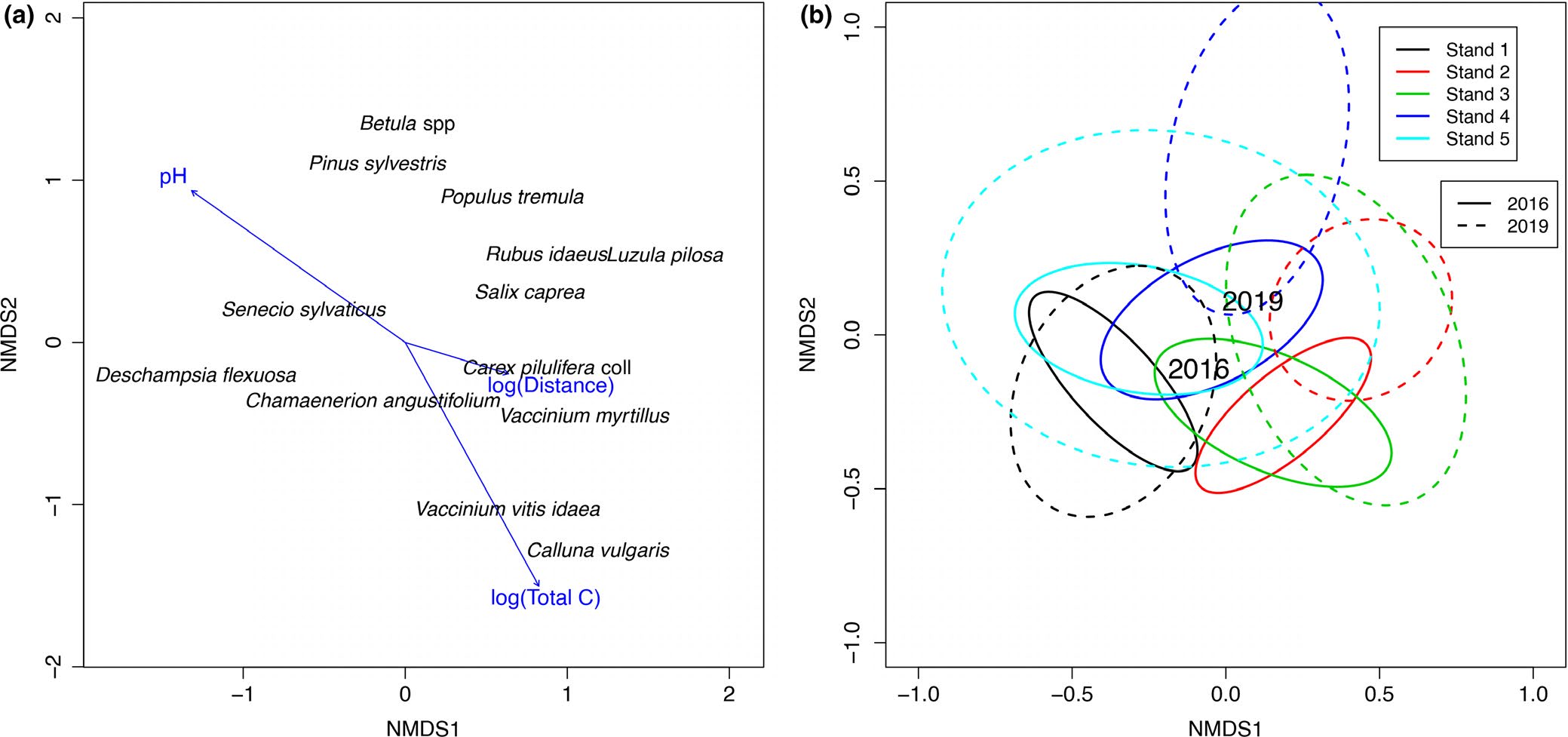
AbstractQuestionsDo burn severity and soil chemistry drive species and trait composition on recently burned clear‐cuttings? Does the spatial distribution of common, easily dispersed colonizers vary with distance to fire perimeter?LocationA 13,000 ha production forest landscape in boreal southern Sweden burned in a wildfire in 2014.MethodsVascular plants and bryophytes were recorded in permanent plots on clear‐cuts two and five years following fire, covering a burn severity gradient. Soil carbon content (reflecting burn severity), pH and nutrients were measured at plot level. Trait data were retrieved from the BIEN and LEDA databases and analyzed using community‐weighted mean (CWM) trait values. Statistical analyses included generalized linear mixed models (GLMMs), non‐metric multidimensional scaling (NMDS) and multivariate ANOVA.ResultsLow burn severity resulted in higher frequency of legacy species (e.g.Vaccinium myrtillus), while high burn severity facilitated colonizing species (e.g.Senecio sylvaticus). Vegetation varied with soil chemistry, expressed through pH. Species composition changed between years and deviated from unburned clear‐cuts. After five years the most common taxa on burned plots were the vascular plantsChamaenerion angustifolium,Betulaspp. andPopulus tremulaand the bryophytesCeratodon purpureusandPolytrichum juniperinum. CWM specific leaf area (SLA) decreased markedly with time and root buds increased with total carbon content in the soil (i.e., toward less severely burned plots), while soil pH was not associated with any studied trait.Chamaenerion angustifoliumdecreased with distance to the fire perimeter, whileCeratodon purpureusincreased.ConclusionsBurn severity and soil pH weakly drive vegetation dynamics in the early phase following fire on clear‐cuts, indicating a large influence of stochastic processes. Deciduous trees are common already after five years and their further expansion will affect light and nutrient availability. To understand future vegetation trajectories on burned clear‐cuts, studies need to incorporate the light factor and links between tree species’ identity and soil nutrient availability.