Year
2025
Publication type
Peer-reviewed article
Journal
Forest Ecology and Management
Volume
597
Pages
123181
Article number
123181
Files
Document
Abstract
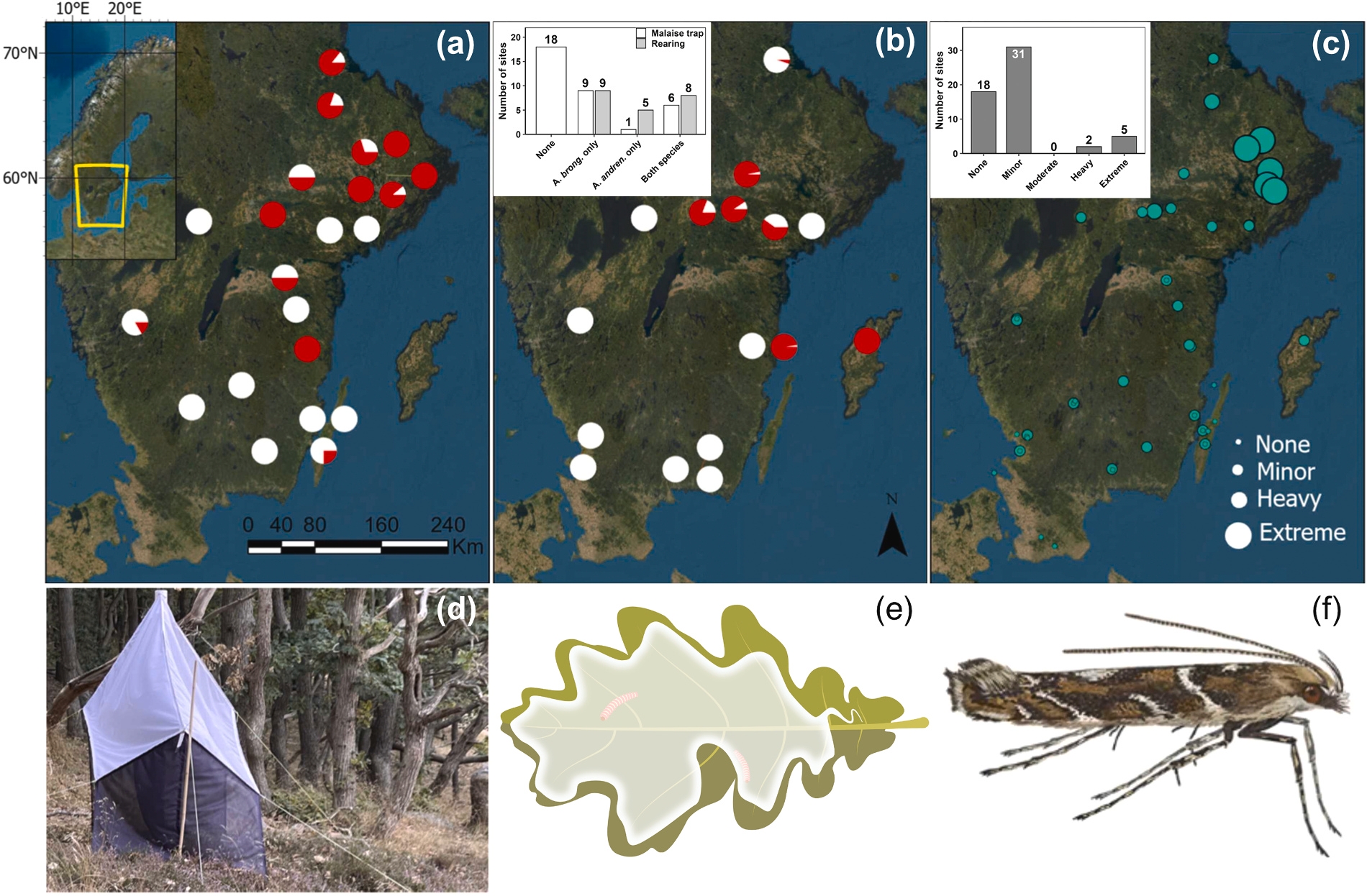
Global forest ecosystems are experiencing increasingly frequent and severe insect outbreaks, driven by complex interactions among climate change, land-use alterations, and shifting species distributions. Species that are morphologically indistinguishable — often referred to as cryptic species — can differ significantly in distribution, host use, and susceptibility to natural enemies and might thereby differ in outbreak dynamics. Yet, the contribution of cryptic species to temporal changes in the frequency and severity of insect outbreak dynamics remains poorly understood. Motivated by recent defoliation events in northern European oak forests, we investigated an emerging leaf-miner outbreak in Sweden. Through targeted surveys, rearing from 22 sites and Malaise trapping at 34 sites (56 sites total), we identified a pronounced spatial clustering of outbreaks at higher latitudes. The newly recognised cryptic species Acrocercops andreneli was strongly associated with these outbreaks, whereas sites with only Acrocercops brongniardella never showed outbreaks. Host-parasitoid networks related to the two cryptic moth species were strikingly similar. Our findings demonstrate the importance of cryptic species for outbreak dynamics and their consequences for host plant health in ways that are easily overlooked by traditional taxonomy. Moreover, such outbreak dynamics cannot always be linked to a lack of top-down control by natural enemies.