Year
2025
Publication type
Peer-reviewed article
Journal
Ecological Entomology
Volume
51
Issue
2
Pages
250-260
Files
Abstract
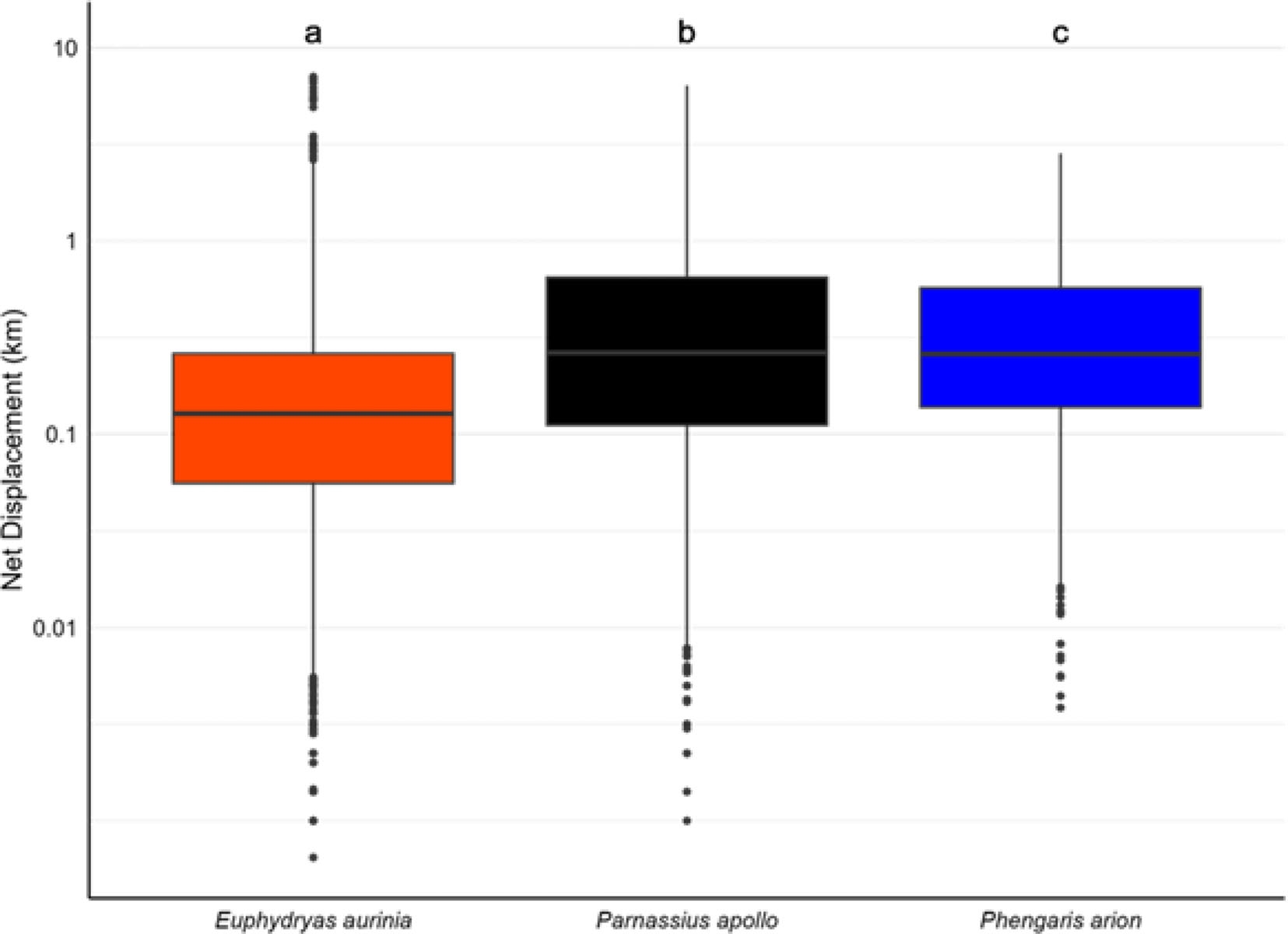
Abstract Movement is fundamental to population persistence and metapopulation dynamics, but robust comparative estimates of dispersal remain scarce for threatened butterflies. Limited quantitative data on movement constrain effective conservation network design. We focused on three threatened butterfly species— Euphydryas aurinia , Parnassius apollo and Phengaris arion —co‐occurring on Gotland, Sweden, which together provide an ideal model for comparative dispersal analysis. To quantify and compare movement patterns among species using extended capture–mark–recapture (CMR) data, test for random‐walk behaviour, and identify the best‐fitting dispersal kernels. CMR datasets for E. aurinia and P. apollo were extended to 2024 and combined with comprehensive data for P. arion , yielding 9670 net‐displacement observations (the distance between the first and last captures) collected from 2017 to 2024. One movement value per individual was used to avoid pseudoreplication, detection probabilities were estimated with Cormack–Jolly–Seber models, and four dispersal kernels were evaluated. Median net displacement differed significantly among species (χ² = 450.14, p < 0.001): E. aurinia showed the lowest value (0.135 km), while P. apollo (0.253 km) and P. arion (0.252 km) were similar. Movements deviated from random‐walk expectations (log–log slope = 0.431 versus 0.5 expected, p < 0.001), indicating area‐restricted movement. Lognormal kernels best described E. aurinia and P. apollo , whereas an exponential distribution fitted P. arion best, with maximum displacements of 8.19, 10.69 and 4.31 km, respectively. Even butterflies traditionally regarded as sedentary exhibit substantial dispersal capacity. Species‐specific movement strategies influence metapopulation connectivity, and the derived parameters provide essential inputs for designing habitat networks within each species's dispersal range.