Year
2025
Publication type
Peer-reviewed article
Journal
Journal of Insect Conservation
Volume
29
Issue
6
Article number
92
Files
Document
Abstract
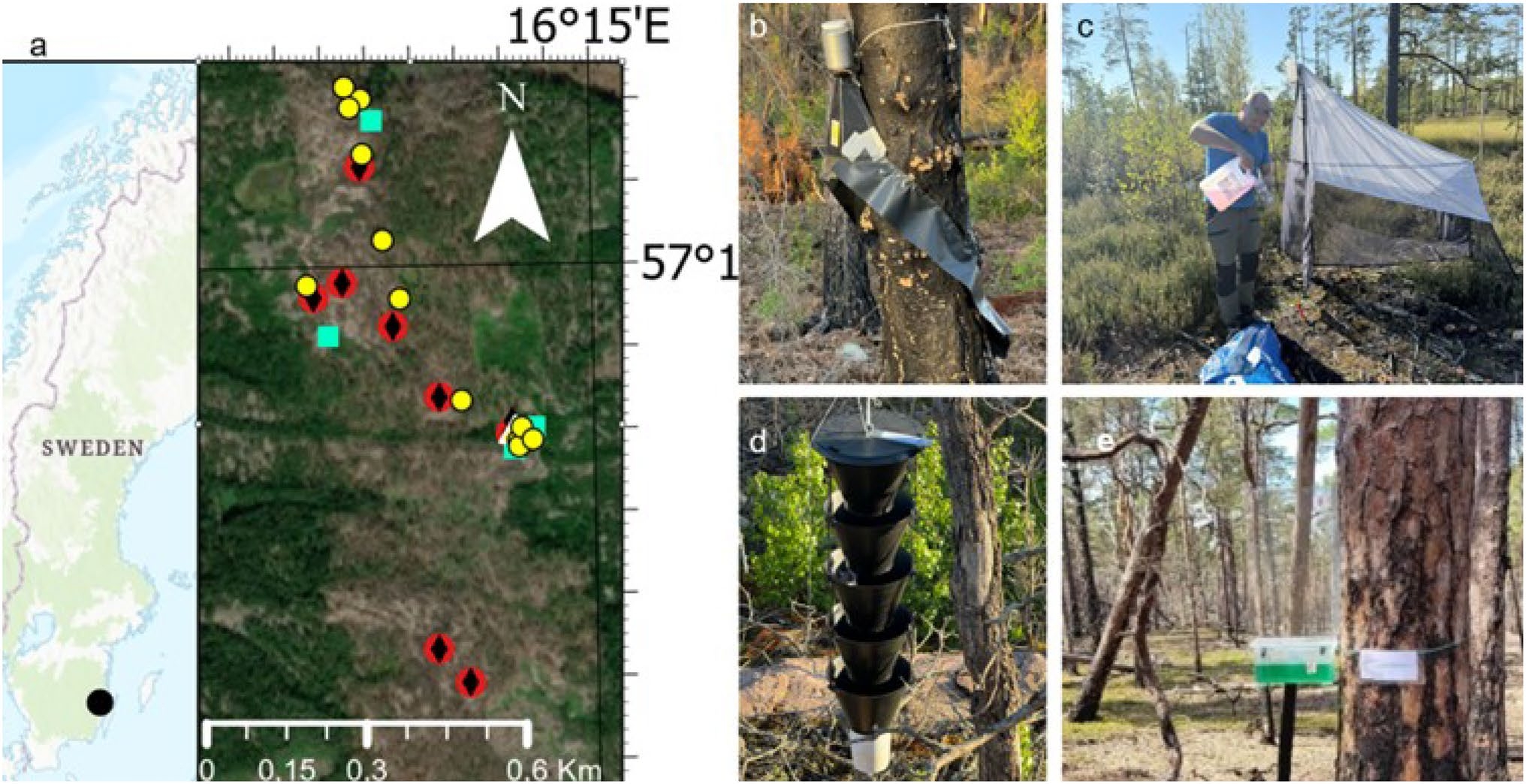
Abstract This study evaluates five sampling methods for characterising saproxylic beetle assemblages in a recently burned (18–21 June 2021) boreal forest in southeastern Sweden. We compared species richness and community composition in samples collected using trunk traps, flight-intercept traps, pheromone traps, Malaise traps, and manual searches, deployed in the Finsjöbrännan nature reserve between 2022 and 2024. A total of 2258 beetle specimens were collected, representing 559 species, including 36 red-listed taxa. Flight-intercept traps yielded the highest species richness (331 species) and abundance, while trunk traps were most effective at detecting red-listed species (13.4% of species captured by trunk traps were red-listed). Coverage-based rarefaction indicated that deploying trunk and flight-intercept traps together could detect approximately 89% of the beetle species (by extrapolated richness); however, this two-method combination necessarily spans different succession stages. Notably, 61.1% of the red-listed species were captured exclusively by a single trap type, underscoring the complementary nature of different sampling approaches. Although non-overlapping sampling years may have confounded the comparisons between trap types, these results suggested that methodological choices, combined with temporal factors, may strongly influence biodiversity assessments in post-fire habitats. We provide evidence-based recommendations for effective sampling protocols, emphasising the need for multi-method approaches and temporal consistency in conservation-focused monitoring. Implications for insect conservation: Post-fire forests represent critical habitats for numerous saproxylic beetles, including many species of conservation concern that depend on recently burned wood. Our results demonstrate that no single sampling method adequately captures the full diversity of post-fire beetle assemblages, as red-listed species often occur exclusively in one type of trap. Therefore, conservation monitoring and biodiversity inventories in burned forests should employ a combination of complementary methods—particularly flight-intercept and trunk traps—to maximise species detection. Standardising temporal deployment and ensuring sampling continuity across years are essential for reliable comparisons among fires and regions. Incorporating such multi-method protocols into long-term monitoring will strengthen assessments of post-disturbance recovery and support evidence-based management of fire-dependent insect communities.