Year
2025
Publication type
Peer-reviewed article
Journal
Forests
Volume
16
Issue
8
Pages
1233
Files
Document
Abstract
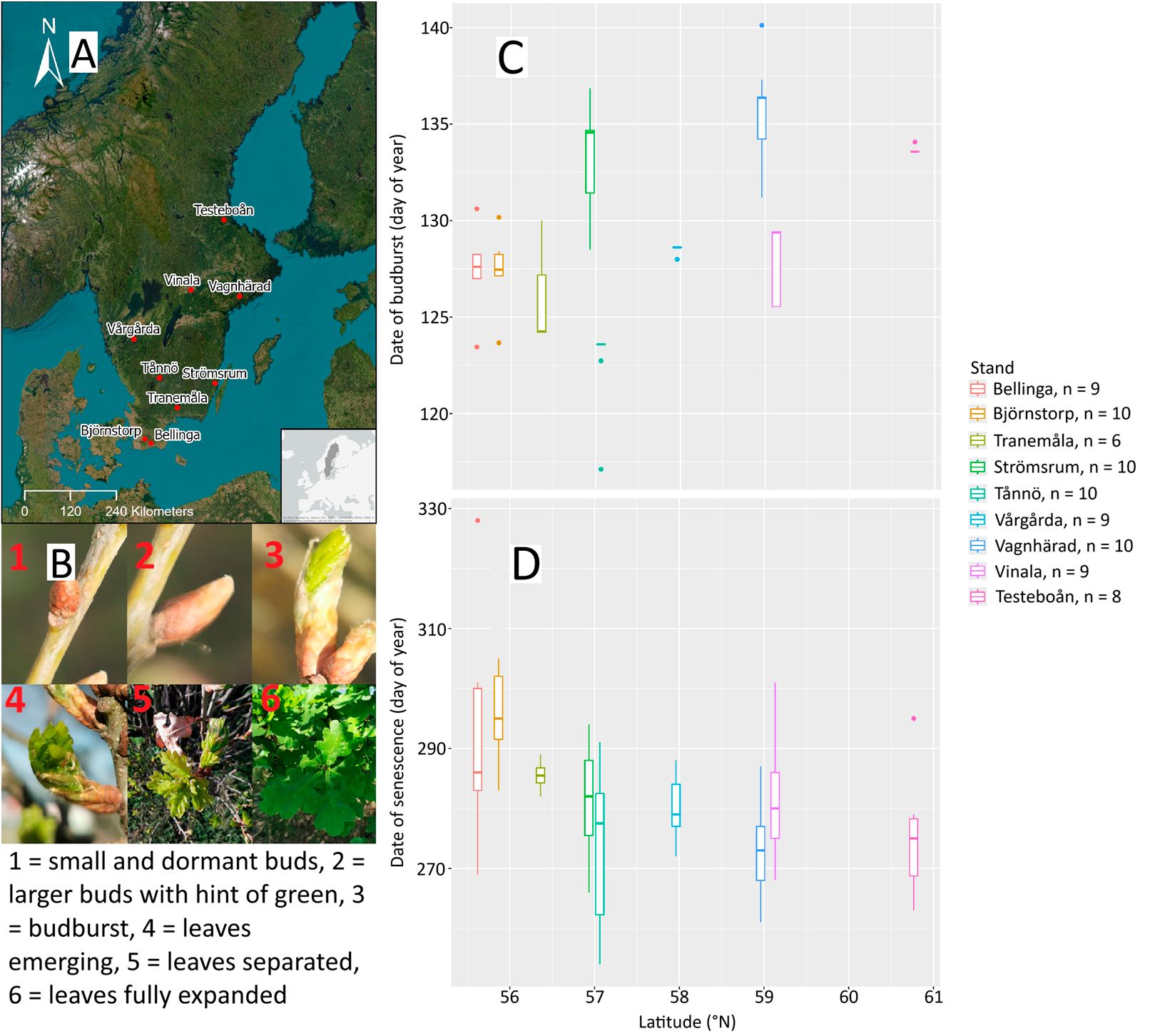
Leaf phenology of trees responds to temperature and photoperiod cues, mediated by underlying genes and plasticity. However, uncertainties remain regarding how smaller-scale phenological variation in cold-limited regions has been affected by modified selection pressures from herbivores, pathogens, and climate conditions, and whether this leaves genetic signatures allowing for projections of future responses. We investigated environmental correlates and genetic variation putatively associated with spring and autumn leaf phenology in northern range margin oak (Quercus robur L.) populations in Sweden (55.6° N–60.8° N). Results suggested that budburst occurred later at higher latitudes and in locations with colder spring (April) temperatures, whereas leaf senescence occurred earlier at higher latitudes. Several candidate loci associated with phenology were identified (n = 40 for budburst and 47 for leaf senescence), and significant associations between these loci and latitude were detected. Functions associated with some of the candidate loci, as identified in previous studies, included host defence and heat stress tolerance. The proportion of polymorphic candidate loci associated with budburst decreased with increasing latitude, towards the range margin. Overall, the Swedish oak population seems to comprise genetic diversity in phenology-related traits that may provide resilience to a rapidly changing climate.