Year
2025
Publication type
Peer-reviewed article
Journal
Forest Ecology and Management
Volume
592
Pages
122837
Article number
122837
Files
Abstract
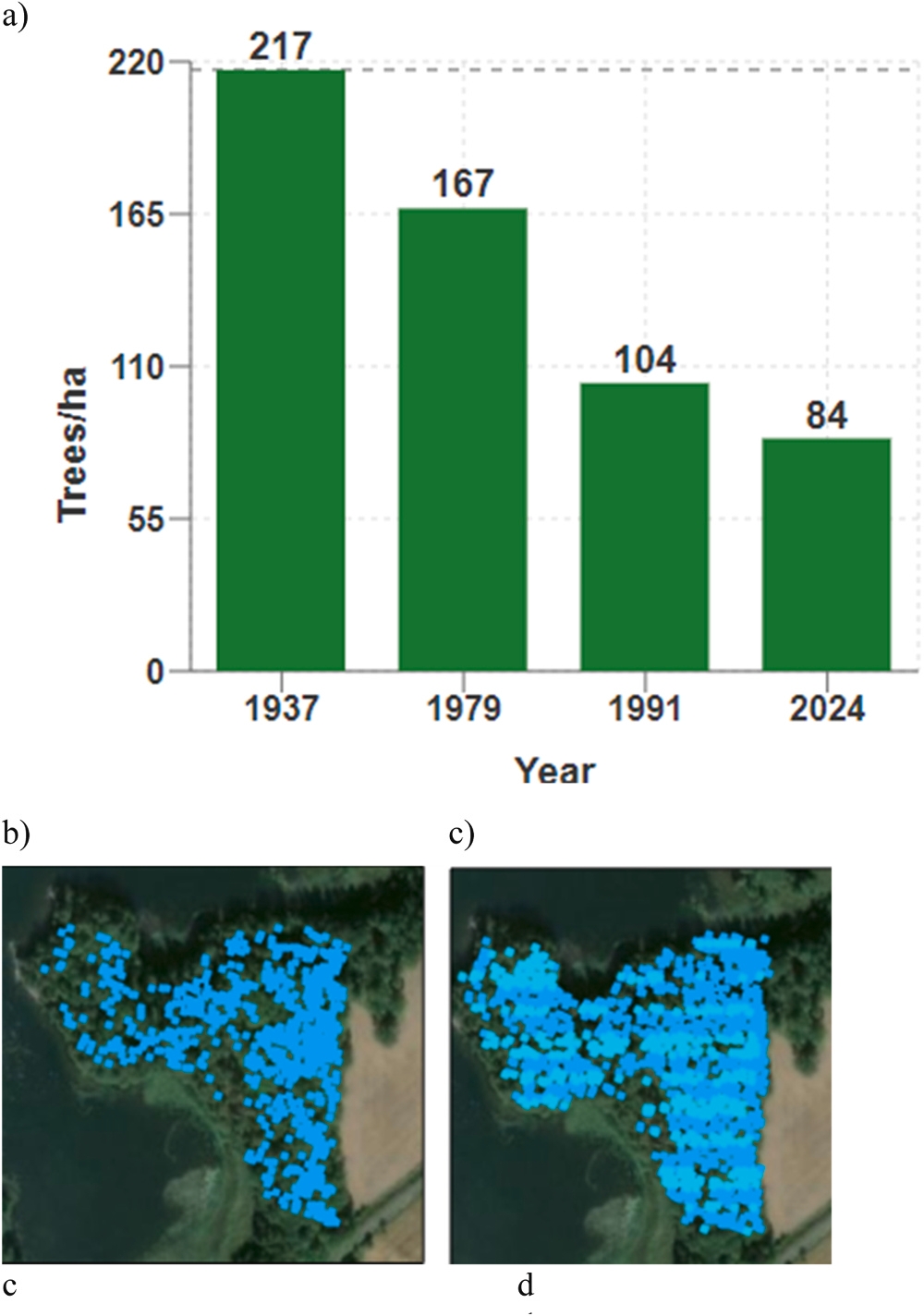
Over the last century, the abandonment of agricultural land has led to significant changes in traditionally managed landscapes and their associated species across Europe. The reserve, Vessers Udde, in southern Sweden, was protected in 1923 when mowing ceased and the area was fenced; no further management of any kind has been conducted since then. Over the century, the wooded meadow has evolved into a mixed forest. We studied how two woody species characteristic of wooded meadows, pendunculate oak (Quercus robur) and common hazel (Corylus avellana), changed over 87 years by analysing tree numbers, basal area, and size distribution since their first mapping in 1937. Over nearly nine decades, oak and hazel have exhibited diverging population trends. Oak density declined by 61 % (from 217 to 84 trees ha⁻¹), yet total basal area increased by 26 %, reflecting selective mortality among smaller trees (87 % mortality at ~10 cm DBH vs 20 % at >50 cm). This size-dependent process, combined with minimal oak recruitment (19.46 trees ha⁻¹ over 87 years), resulted in a marked shift toward larger stems and a more fragmented canopy. In contrast, hazel abundance expanded by 168 % since 1920, with crown cover increasing by 84 % since 1937. Despite substantial differences in demography, spatial analyses show no strong competitive exclusion between oaks and hazel. These findings underscore how the cessation of traditional management reshapes stand structure, favouring hazel proliferation while limiting oak regeneration.