Year
2025
Publication type
Peer-reviewed article
Journal
Forest Ecology and Management
Volume
597
Pages
123117
Article number
123117
Files
Document
Abstract
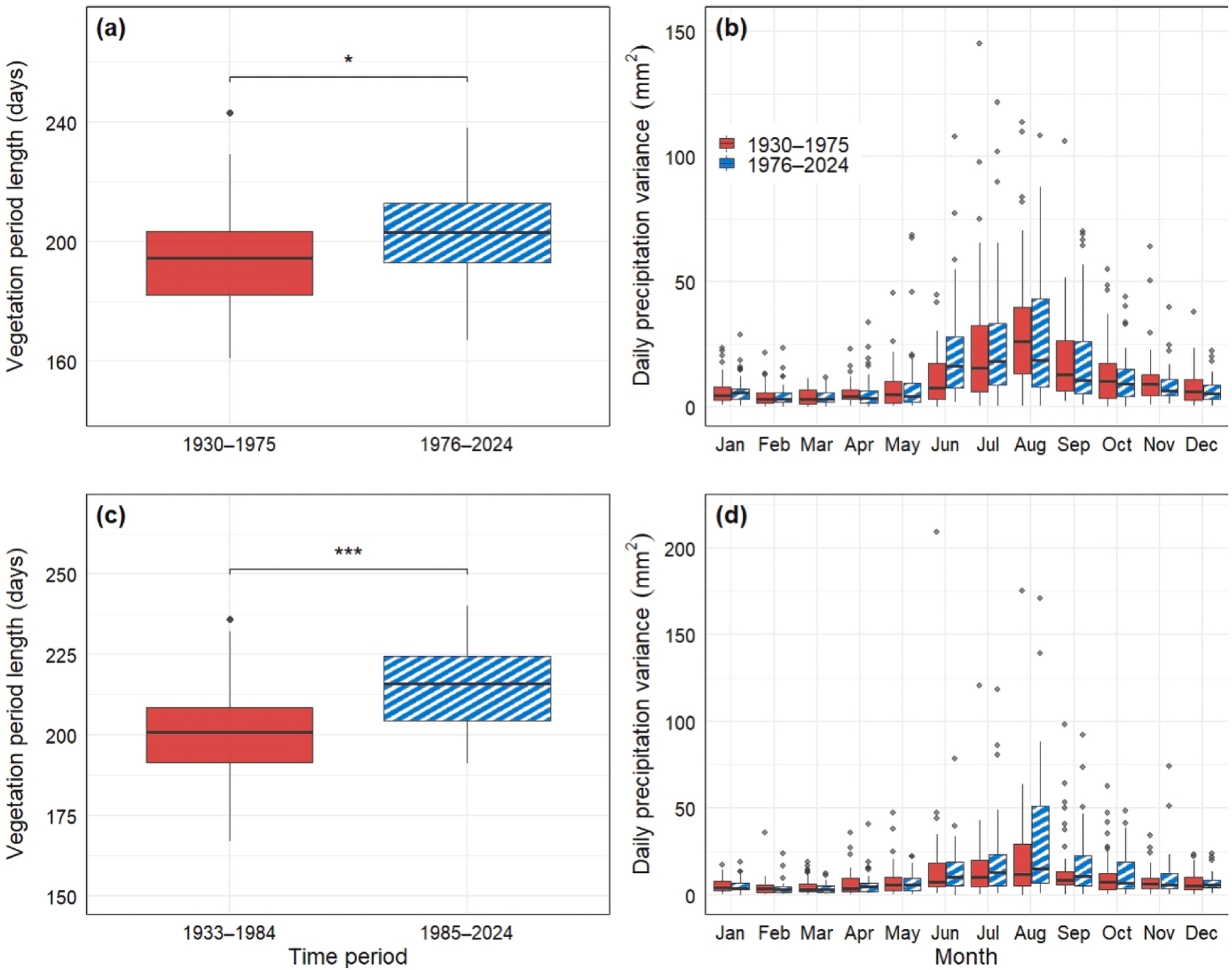
Understanding the long-term performance of large trees is crucial for predicting forest responses to environmental change. We compared oak growth and mortality in two Scandinavian parks over two consecutive 50-year periods spanning nearly a century, with different temperatures and rainfall patterns. Tree diameter at breast height was measured, and survival status was recorded at three points in time. In Dyrehaven, a deer park with scattered and grouped trees, 641 oaks were followed, and annual mortality was 0.386 % per year (CI 0.333; 0.440). In Djurgården, a former deer park now partly covered by forest, 59 oaks were followed, and the annual mortality rate was 0.992 % (0.712; 1.374). Since 1930, growing seasons have lengthened by 9 days in Stockholm (Djurgården) and 15 days at Falsterbo (proxy for Dyrehaven), while precipitation variability has increased only in the latter. Mortality did not differ between time periods. Despite a longer growing period, annual basal area growth was greater in the first period than in the second. Our results show that despite mortality and slower individual growth rates over time, the standing biomass of large oaks in open parkland can continue to rise, underlining their importance as long-term carbon stores. Ensuring the long-term availability of large oaks in these parks will require increased recruitment efforts, forward-looking management, and adaptive conservation strategies.