
Year
2025
Publication type
Peer-reviewed article
Journal
Journal of Applied Ecology
Volume
62
Issue
8
Pages
1929-1938
AI podcast
Audio file
Files
Abstract
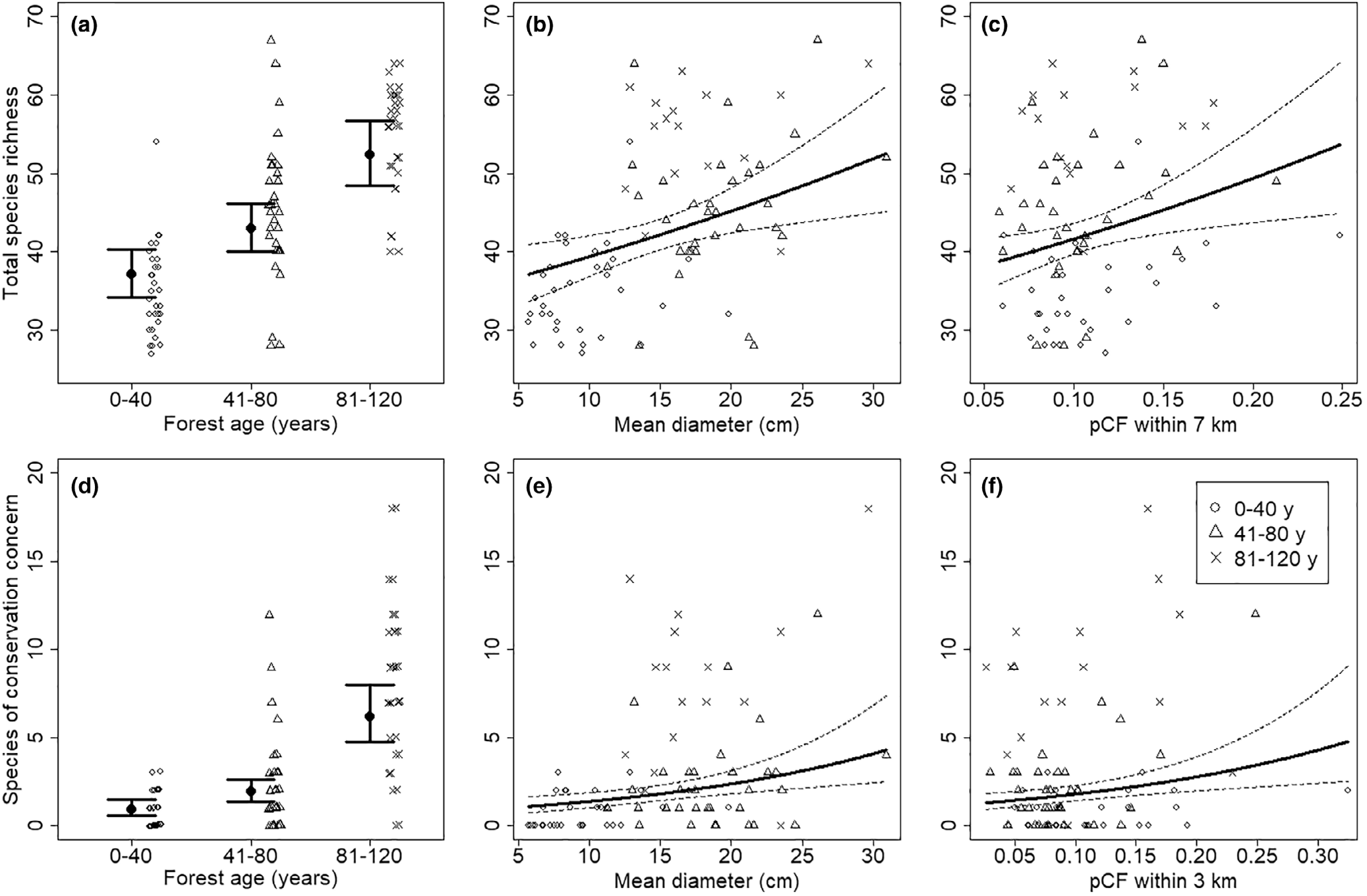
Abstract Boreal forest landscapes are rapidly transformed through expanding clearcutting forestry, leading to a decline in forests with long tree continuity and an increase in even‐aged production stands. The role of remnant forests in supporting biodiversity within production forest landscapes remains poorly understood. Northern Europe provides an ideal setting for studying mosaics of clearcut and remnant continuity forests, given its long history of clearcutting and the prevalence of even‐aged forest stands. New remote‐sensing techniques have enabled the identification of forests in boreal Sweden that have maintained permanent tree cover at least since the 1950s (‘continuity forest’), meaning that they have likely never been clearcut, with removal of all trees. Using these data (including production forest as well as protected forest), we randomly selected 16 areas, each 225 km2 in size, with the proportion of continuity forest ranging from 2% to 25%. In each study area, we selected four even‐aged production forest stands aged 0–80 years and one selectively harvested (never‐clearcut) production stand aged 81–120 years. As model organisms for assessing biodiversity, we used epiphytic lichens on randomly selected Norway spruce Picea abies trees. We recorded 164 epiphytic lichen taxa on 926 trees. Species richness (including species of conservation concern) in the even‐aged forests <80 years old increased with the proportion continuity forest in the surrounding landscape. In contrast, there was no relationship between the richness of lichens and the proportion continuity forest for the older, selectively harvested production forests. Our results suggest that continuity forests are an important dispersal source for even‐aged production forests since almost all of the epiphytic lichen occurrences represent new colonization. Our results also show that continuity production forests >80 years old are important to epiphytic biodiversity since they host many species of conservation concern. Synthesis and applications. Our study has relevance for forestry and conservation across the boreal biome where a continued rapid expansion of clearcutting into primary forest landscapes is likely. Preserving continuity forests for the future would enrich the epiphytic biodiversity of younger, even‐aged production forests due to their function as dispersal nuclei. The remnant continuity forests are also conservation targets in their own right due to their rich lichen diversity.