Year
2025
Publication type
Peer-reviewed article
Journal
Global Ecology and Conservation
Volume
64
Pages
e03968
Article number
e03968
Files
Document
Abstract
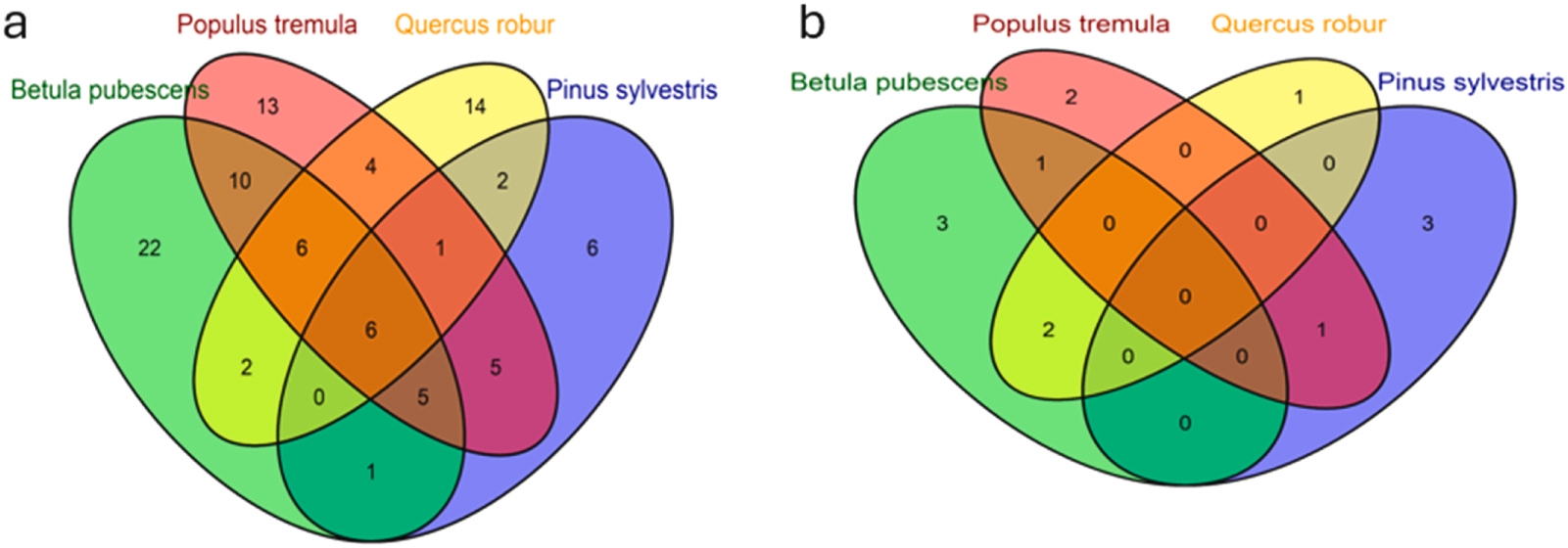
Wildfire is the dominant natural disturbance in boreal ecosystems, yet the extent to which recently burned trees of different species filter arthropod assemblages remains unclear. We quantified trunk-ascending arthropods and saproxylic beetles on fire-damaged trunks of four common boreal trees – Betula pubescens, Populus tremula, Pinus sylvestris and Quercus robur – in a 2021 burn in south-eastern Sweden. Twelve collar traps (three per species) operating for 189 days captured 9178 arthropods from 16 higher taxa, including 1427 beetles (96 species, 13 of which are red-listed). The overall arthropod assemblage varied only weakly with host tree and was primarily driven by Collembola, whereas beetle composition differed markedly, with host species identity explaining 52 % of the multivariate variation. B. pubescens supported the highest beetle richness (52 species) and P. tremula the greatest abundance (848 individuals, 60 %). Species turnover among hosts was high (Jaccard similarity = 0.17–0.36). Thirty beetle species, among them the Vulnerable Dircaea australis and Near-Threatened Triplax rufipes, showed significant preferences for a single tree species. Thus, post-fire trunks retain strong host specificity for beetles but not for the broader arthropod fauna; conserving a mosaic of burned stems across multiple tree species will maximise beetle richness and retain threatened taxa.