Year
2026
Publication type
Peer-reviewed article
Journal
Biological Conservation
AI podcast
Audio file
Video file
External URL
Files
Document
Abstract
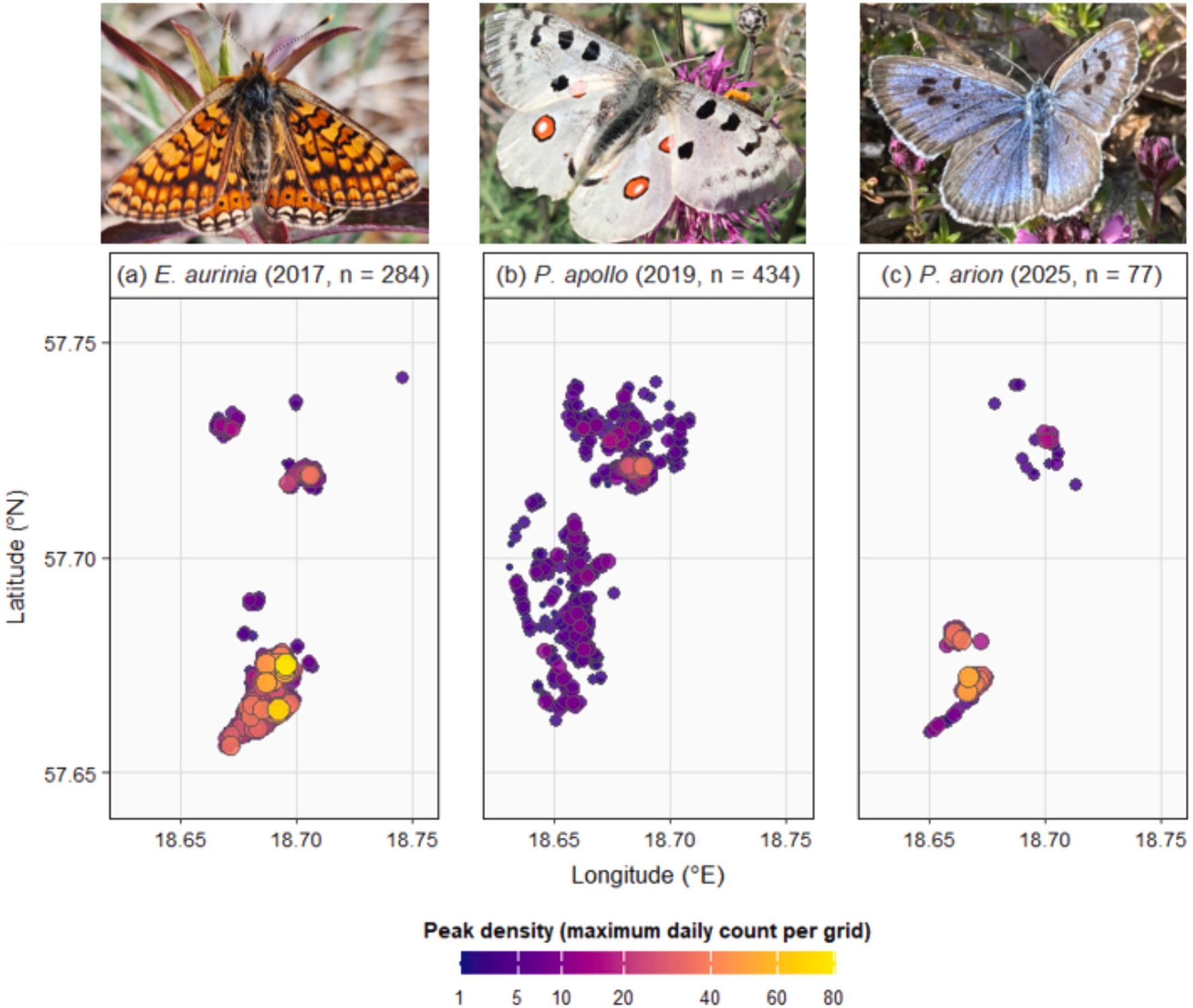
Conservation planning typically relies on species occurrence records, yet where individuals concentrate within occupied landscapes may matter more for population persistence than where species are merely detected. We applied Lorenz curves and Gini coefficients, metrics originally developed to quantify wealth inequality, to spatially referenced abundance data for three threatened grassland butterflies protected under the EU Habitats Directive: Euphydryas aurinia, Parnassius apollo, and Phengaris arion. Across a 60 km2 landscape on Gotland, Sweden, subdivided into 1-ha grid cells (795 species × grid observations), peak densities were strongly rightskewed and spatially concentrated for all three species. The top 19% of occupied grids accounted for 44–53% of the summed peak counts, and capturing 50% of the summed peak counts required only 20–25% of occupied grids. Phengaris arion was the most spatially concentrated species, and P. apollo the least, a ranking that was robust across Gini coefficients and concentration metrics. Habitat associations were species-specific: ground moisture and grassland proportion were positively associated with peak density for E. aurinia and grassland proportion for P. apollo, whereas Ph. arion peak densities declined with increasing grassland proportion and were poorly predicted by the landscape-scale habitat metrics examined. These findings demonstrate that high-density supersites can be difficult to identify from occurrence-based assessments, yet may represent important targets for population-focused conservation. The Lorenz–Gini framework provides a transferable, metric-based approach for identifying such sites across taxa, complementing area-based conservation targets by explicitly considering where populations actually persist.