Year
2026
Publication type
Peer-reviewed article
Journal
Biological Conservation
Volume
313
Pages
111588
Article number
111588
Files
Document
Abstract
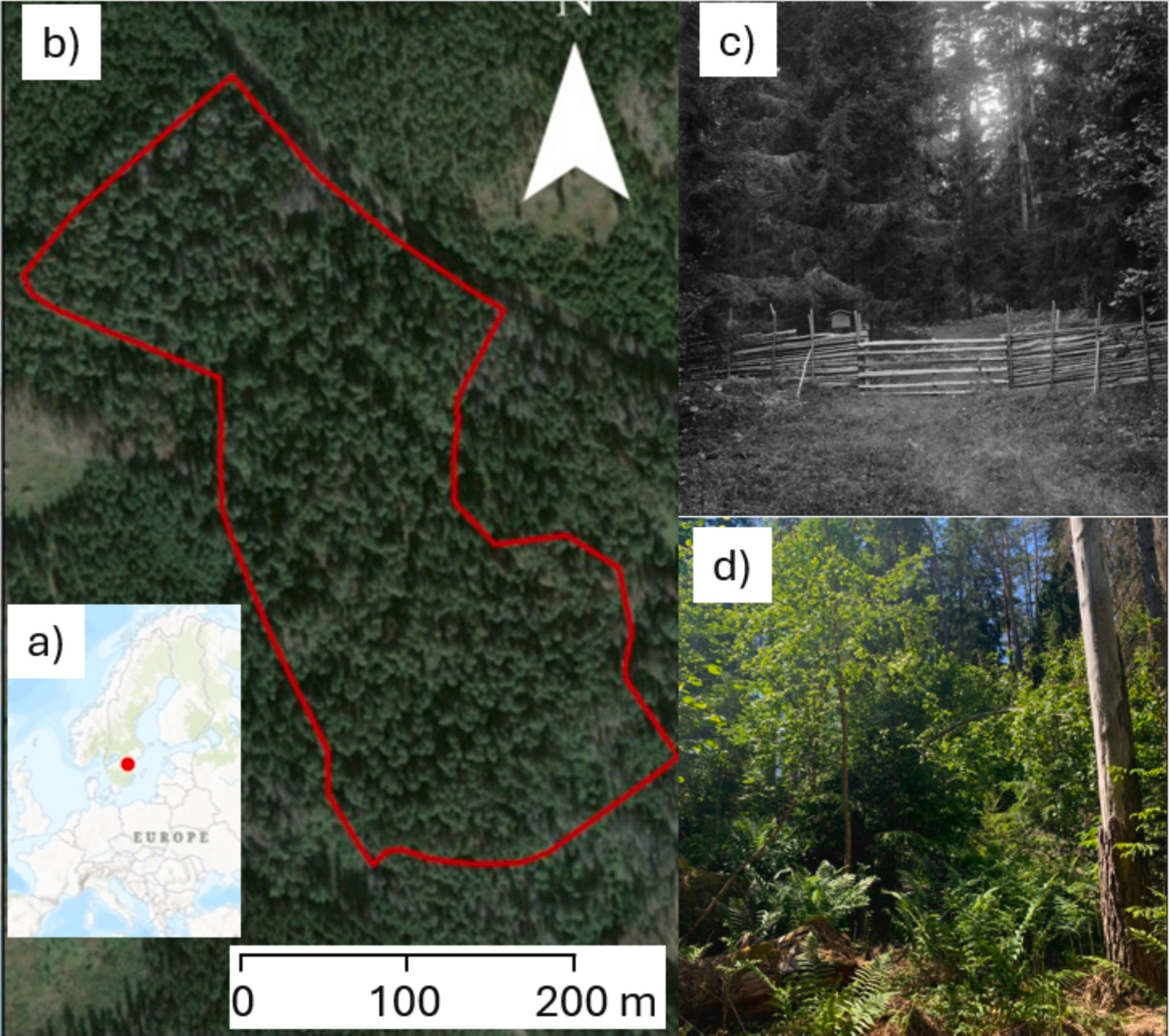
Nature reserves are expected to recreate old-growth conditions through passive succession, yet long-term, stand- wide tests are rare. We studied a hemiboreal forest in south-eastern Sweden, which has been protected since 1923. We resurveyed every tree within 10.4 ha. 88 years after the initial 1937 census, to investigate whether protection alone restores structure without eroding compositional diversity. All stems present in 1937 (≥ 8.89 cm diameter at breast height, DBH) were relocated and matched to their 2025 status; all living recruits ≥1 cm DBH were mapped. Living stem density declined 22 % to 412 ha− 1, yet basal area rose 6 % to 40.7 m2 ha− 1 and living volume 12 % to 451 m3 ha− 1. Deadwood accumulated to 190 m3 ha− 1, and large living trees (≥ 45 cm DBH) increased 20 % to 109 ha− 1. Tree species richness increased from five to thirteen, but stand dominance shifted towards shade-tolerant Norway spruce, now 62 % of stems; Scots pine density fell 40 %. Neighbourhood basal area strongly enhanced survival (odds ratio 7.8), especially for pine, whereas wetter microsites reduced survival. Recruitment (6276 stems) was 90 % spruce and concentrated where the 1937 stand had been densest; pine recruitment declined with increasing moisture. In this small reserve embedded in a managed forest landscape, strict protection rebuilt structural capital but shifted composition towards spruce dominance. Natural disturbances (windthrow, beetles) generate canopy gaps that maintain structural heterogeneity, yet outcomes are constrained by reserve size and landscape context rather than representing universal expectations for protected forests.