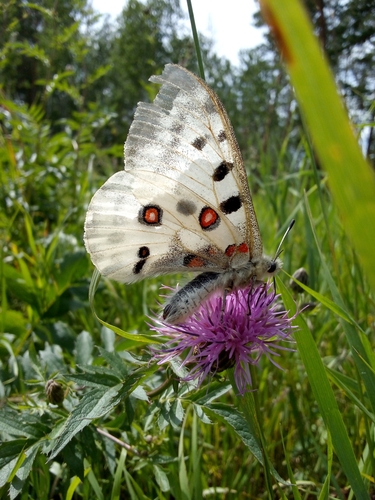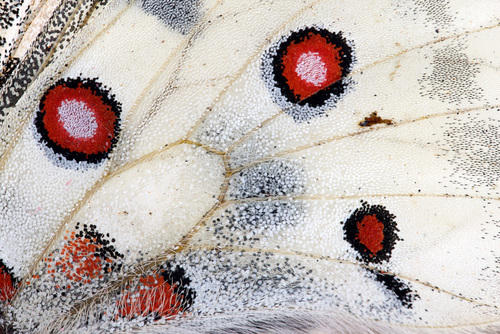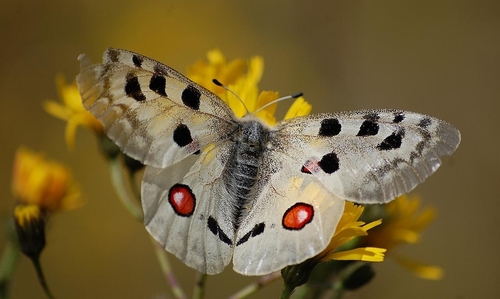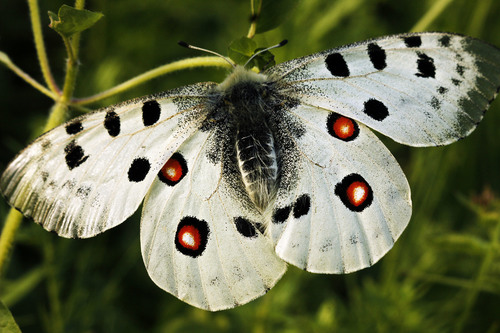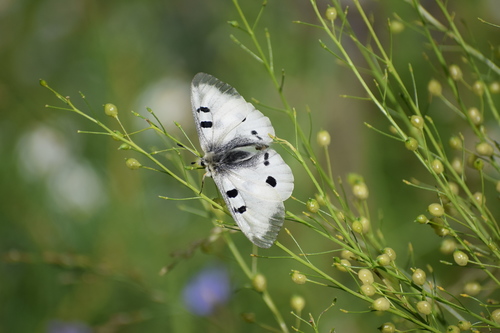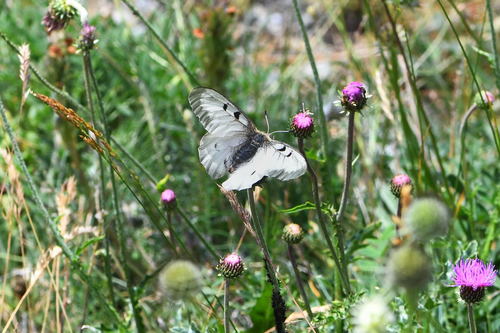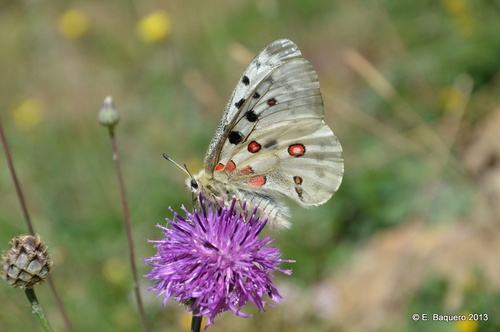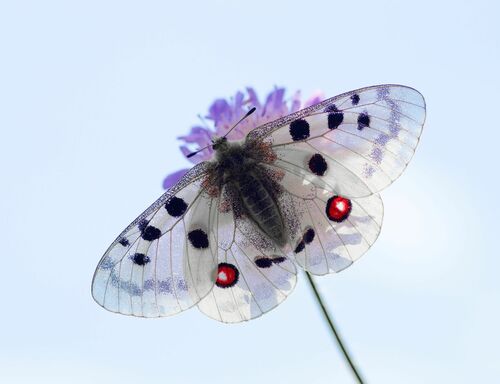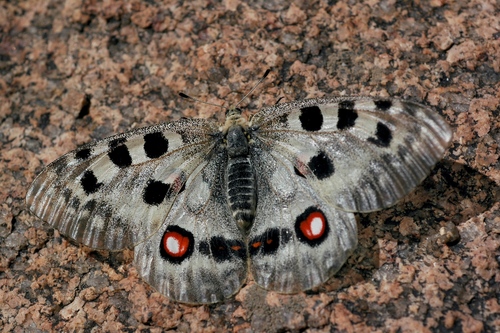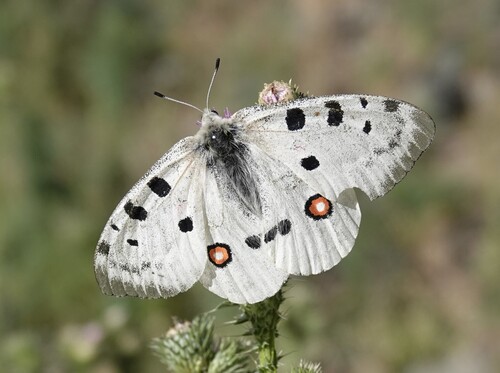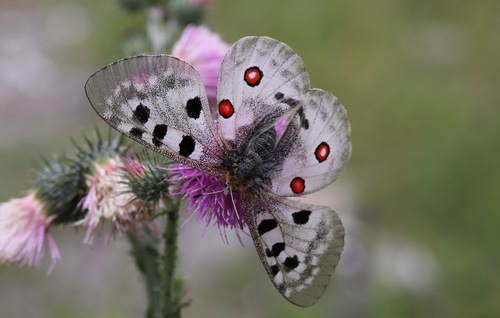
Apollo - Parnassius apollo (Linnaeus, 1758)
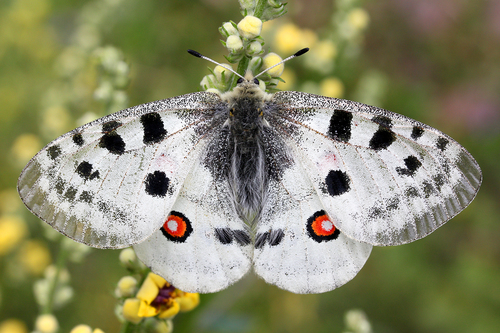
Source: Wikipedia
Synonyms 50
- 139,778 GBIF occurrences
- 10,070 iNaturalist observations
The species is listed on the Habitats Directive Annex IV, Bern Convention Appendix II and CITES Appendix II. The species is legally protected in many countries. This species occurs in a number of protected areas across its range; and only in protected areas in Poland. No specific conservation actions are needed at the European level, but in countries where the species is declining, important habitats should be protected and managed, particularly at low altitude sites to prevent overgrazing and/or scrub and tree invasion by maintaining or restoring traditional low intensity agricultural grazing practices. The effects of conservation actions should be monitored by butterfly monitoring schemes.
The Apollo occurs in mountainous areas on steep, sunny slopes with sparse vegetation. In Europe, there are many different sub-species, forms and aberrations, because of the very divided nature of the distribution area and as a consequence, populations are often isolated. Separated by mountains, the populations develop independently of one another, so that quite marked differences arise. However, their ecology is similar. The butterflies are fond of visiting thistles and other flowering plants. The female lays its eggs singly or in small groups on or near the larval hostplant stonecrop (Sedum spp.). The eggs develop but the tiny caterpillar hibernates inside the eggshell or as newly hatched larva in close proximity. In spring it starts feeding on the buds of the hostplant. The caterpillars of later instars also eat the leaves. When it is time to pupate, the caterpillars look for a safe place between the stones, where they then spin a flimsy cocoon in which to pupate. The Apollo has one generation a year. Habitats are alpine and subalpine grasslands (23%), dry calcareous grasslands and steppes (19%), inland cliffs and exposed rocks (11%), screes (9%), coniferous woodland (7%), broad-leaved deciduous forests (7%) (van Swaay et al. 2006).
This is a local species, restricted to (semi-) natural habitats. Declines in distribution or population have been reported in several countries. It is classed as Regionally Extinct in Romania and Ukraine; as Critically Endangered in Albania, Czechia and Poland; and Endangered in Finland, Germany and Slovakia (Maes et al. 2019). It is also classed as Vulnerable in Bosnia and Herzegovina, Croatia, Serbia and Slovenia; and Near Threatened in Austria, Bulgaria, Greece, North Macedonia, Norway, Sweden and Switzerland.Article 17 reporting for this Habitats Directive butterfly (https://nature-art17.eionet.europa.eu/article17/species/summary/?period=5&group=Arthropods&subject=Parnassius+apollo®ion=) for the period 2013-18 indicates this species has a unfavourable conservation status in most countries.
European regional assessment: Least Concern (LC)EU 27 regional assessment: Least Concern (LC)Within the European region, the Apollo occurs in most of the large mountainous areas of the continent. This species is listed as Least Concern, as it has been evaluated against all the IUCN criteria and does not meet the thresholds for any category of threat in Europe and EU 27 region.
This species is not believed to face major threats at the European level. In general high altitude populations in the Alps and other mountain ranges are not threatened, but the species has declined at lower altitudes where the Apollo remains threatened by a lack of suitable grassland habitat management (both agricultural intensification and abandonment). At lower altitudes, habitat loss and changing habitat quality has also led to increasing habitat fragmentation and isolation of remaining populations and sub-populations. The species is attractive to collectors, especially the subspecies of small lowland populations, but there is no evidence to determine whether this is contributing to its decline.