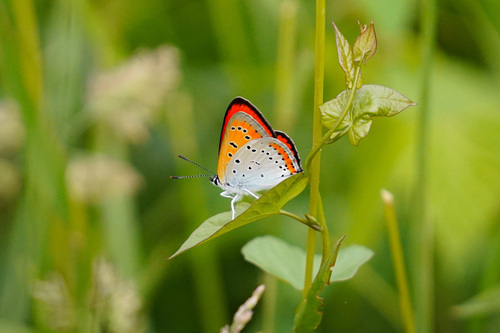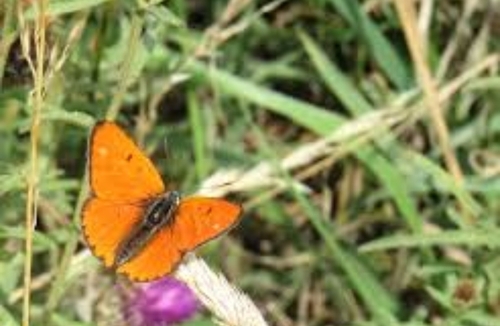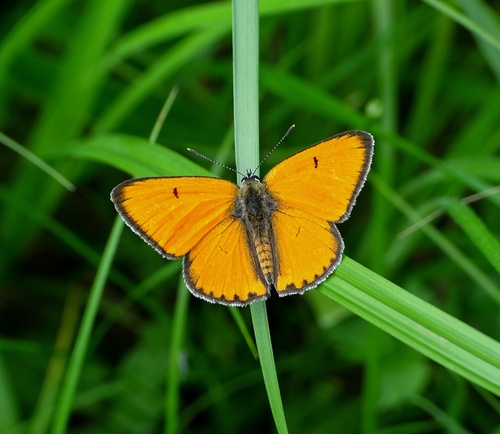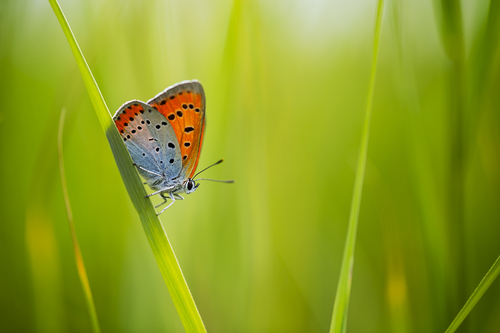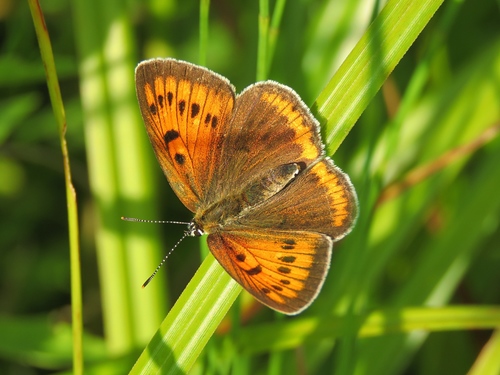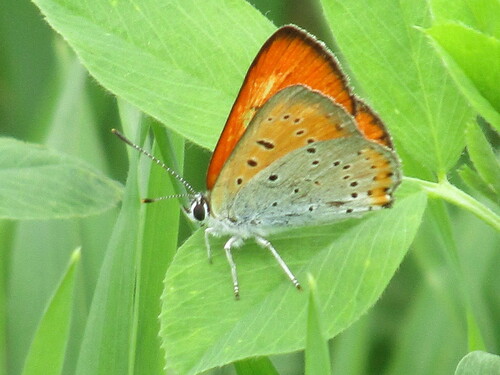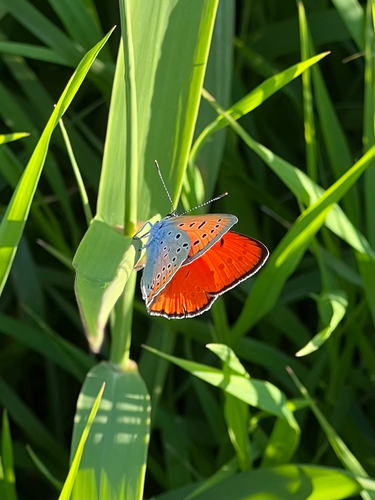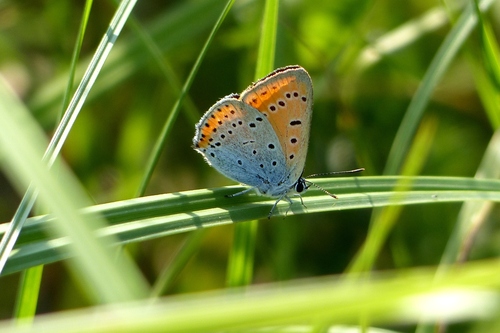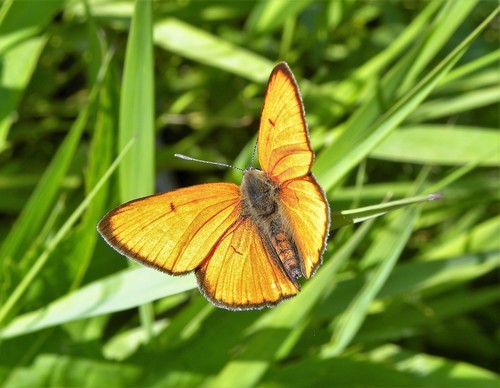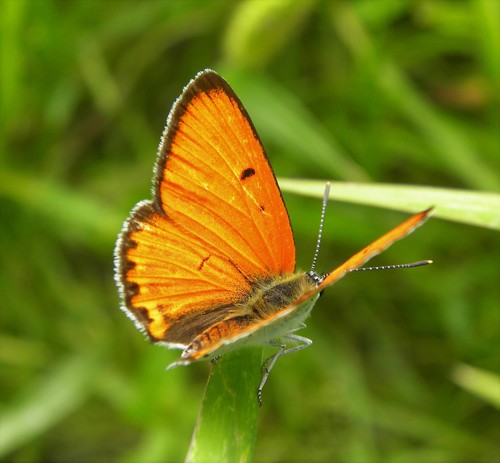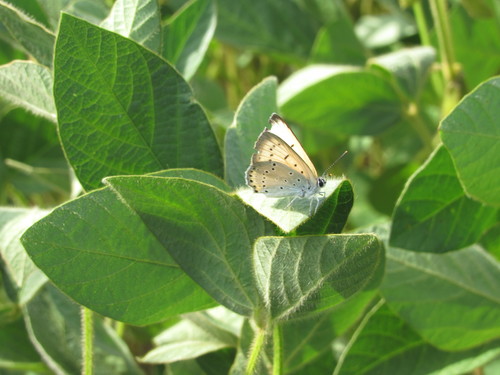
Large Copper - Lycaena dispar (Haworth, 1803)
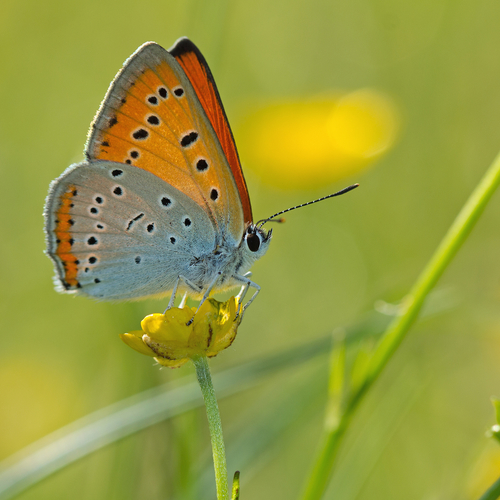
Source: Wikipedia
Synonyms 50
- 54,155 GBIF occurrences
- 9,842 iNaturalist observations
The species is listed on the Habitats Directive Annexes II and IV and Bern Convention Appendix II. This species occurs in a number of protected areas across its range; and only in protected areas in the Netherlands. It is unknown if all populations are in Natura 2000 protected areas in Estonia, Finland and Germany. More research is needed on the distribution and ecology of the species. In countries where the species is declining, important habitats should be protected and managed to prevent the loss or degradation of marshy breeding sites (e.g. by hydrological control) and to prevent scrub and tree invasion by maintaining or restoring traditional low intensity agricultural grazing practices. The effects of conservation actions should be monitored by a butterfly monitoring scheme.
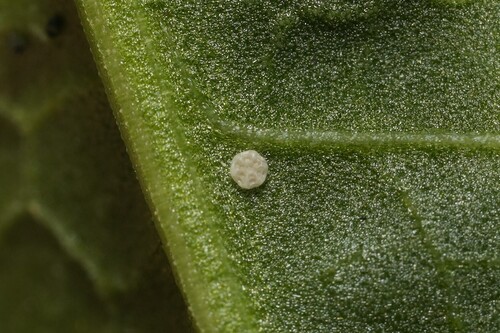
The Large Copper occurs in marshy habitats and on the peaty banks of lakes, rivers and streams and more to the east also on wastelands. Nectar plants are important, especially for the females. Eggs are laid on large sorrels (Rumex spp.) like R. crispus, R. obtusifolius and Water Dock (R. hydrolapathum), but never on Common Sorrel (R. acetosa) or Sheep's Sorrel (R. acetosella). The young caterpillars first eat from the underside of the leaves, making the characteristic 'windows'. Later caterpillars feed on the whole leaf. They hibernate when half-grown between withered leaves at the base of the foodplant. They are sometimes associated with ants (Myrmica rubra and Lasius niger). The Large Copper has several sub-species in Europe. The largest of them, L. d. batava, is confined to the extensive wetlands in the north of the Netherlands. The males of this subspecies occupy territories in the warmest places in depressions in the vegetation. Their caterpillars feed only on Water Dock (Rumex hydrolapathum). There are two smaller subspecies, L. d. rutila and L. d. carueli, that use other large sorrels as larval hostplants. The subspecies L. d. batava has one generation a year and the other subspecies two or sometimes even three. Habitats are humid grasslands and tall herb communities (26%), water-fringe vegetation (14%), fens, transition mires and springs (11%), mesophile grasslands (8%), broad-leaved deciduous forests (7%), blanket bogs (5%), dry calcareous grasslands and steppes (5%) (van Swaay et al. 2006).
Although widespread in its European range, this species is local and restricted to areas with sufficient good quality (semi-) natural habitat. Some subspecies, are extremely local and threatened (e.g. Lycaena dispar batavus) or even extinct (L. dispar dispar). Declines in distribution or population have been reported in several countries. It is classed as Regionally Extinct in Denmark, the United Kingdom; and as Critically Endangered in the Netherlands (Maes et al. 2019). It is also classed as Vulnerable in Albania, Germany, Greece, North Macedonia, Romania, Slovenia and Switzerland; and Near Threatened in Bosnia and Herzegovina, Croatia, Finland, Lithuania.Article 17 reporting for this Habitats Directive butterfly (https://nature-art17.eionet.europa.eu/article17/species/summary/?period=5&group=Arthropods&subject=Lycaena+dispar®ion=) for the period 2013-18 indicates this species is now largely in favourable conservation status. During the last 10 years its population has declined by 34% in both Europe and the EU 27 (BCE and UKCEH 2024), although this trend is thought to be strongly biased towards north western Europe.
European regional assessment: Least Concern (LC)EU 27 regional assessment: Least Concern (LC)Within the European region, the Large Copper is widespread over much of the continent. In Europe and the EU 27 its population is reported to have declined by over 30% during the last 10 years based on existing data (source: European Butterfly Monitoring Scheme). This decline exceeds the threshold for threatened species status under criterion A, but the Large Copper is classed as Least Concern because there is probably strong bias towards north western Europe in these data, therefore it is thought that the declines across Europe and the EU 27 region do not meet the thresholds to be assessed as threatened. Article 17 reporting for this Habitats Directive butterfly for the period 2013-18 indicates this species is now largely in favourable conservation status.
Where the species occupies marshy habitats, it is threatened by reclamation, groundwater extraction or desiccation. Grassland and wasteland habitats become unsuitable if they are abandoned and become invaded by shrubs and trees.